

When deciding where to source wholesale wall art for retail stores, choose the route that controls the dominant risk. Stock wholesalers suit ready designs; manufacturers support repeatable physical specifications; print specialists lead artwork output; sourcing partners can coordinate mixed processes when ownership is transparent.
This procurement guide moves from retail brief to comparable RFQ, rights record, sample approval, packaging validation, pilot release and reorder. It is not a vendor directory, styling rulebook or legal advice.
Wall art is bought as a range but produced as physical SKUs. Assortment, rights, product, hardware, pack and approval records must stay aligned.
1. Build the retail wall-art brief before searching for suppliers
A useful brief states what the range must do, what is fixed and what may still change.
Define the shopper, room, channel and price role
Write a one-page commercial context: destination market, sales channel, shopper, room or project setting, launch date, opening quantity range, expected retail bands and reorder model. A hotel corridor program may value repeated dimensions, controlled finish and installation records. A gift shop may need smaller, ready-packed items at accessible prices. An online retailer may place more weight on packed dimensions, parcel damage and consistent product photography.
Give every proposed SKU one job: entry purchase, core replenishment, feature display, gallery-wall add-on or seasonal newness. The job controls how much depth the buyer gives it and what evidence matters. Decision 1: select one primary role before requesting a quote. Boundary 1: a visual theme is not a commercial role. Two attractive designs at the same size, finish and price can still duplicate each other.
Write the owner and success measure beside the role: margin, attachment rate, display impact, reorder rate or a defined seasonal exit. This turns taste into a decision that can be reviewed after launch.

Apply the range test in the figure before sampling. If two items solve the same display job, keep the stronger one or deliberately change size, format, price or selling context. This protects stock depth in the products that must actually reorder.
Build a size ladder from real display zones
Consumer searches often ask what size wall art belongs over a couch. For a retail buyer, the useful answer is not a universal fraction. The buyer should record the intended display zone, usable wall width and height, furniture or fixture relationship, viewing distance, product orientation, depth, net weight and installation constraints. A percentage of furniture width can be a visual starting point, but it does not control protrusion, weight, wall substrate or packed volume.
Create small, core and feature size bands that change the selling job. For example, a small framed print may support gifting and gallery-wall add-ons; a core landscape piece may work above a console; a feature metal relief may anchor a room set. Decision 2: approve outside dimensions, depth, orientation and weight together. Do not approve only the front view.

The output should list product width, height and depth; image opening or panel layout where relevant; net weight; rear-hardware position; packed width, height and depth; gross weight; and planned display role. Those fields let a buyer compare a metal wall-art direction with framed or printed alternatives on more than appearance.
Balance SKU breadth with stock depth and identification
Every added size, colour, frame or pack can become another sellable variation. GS1 US explains that product variations such as colour, size, style or pack count require distinct product identification when GTINs are used. A design offered in three sizes and three finishes can therefore create nine stock identities before packaging variations are added.
Labelled hypothetical example 1: a retailer plans 12 designs, two sizes and two finishes. That creates 48 sellable variants. At six opening units each, the order already contains 288 pieces, but only six units support each variant. If the same budget funds 18 carefully chosen variants at 16 units each, the range still totals 288 pieces and gives the core lines more meaningful depth. This is a planning example, not a universal SKU target.
Decision 3: build a SKU tree before negotiating MOQ. Record design, size, finish, frame, pack and barcode owner. Protect depth in core items before adding cosmetic variations, and state which components may be shared across the range.
Also reserve a status for discontinued, replacement and test SKUs so old barcode, artwork or pack records cannot reappear silently during a later quotation.
2. Match wall-art formats to manufacturing and retail risk
Printed canvas, framed art, metal relief and multi-panel sets require different controls.

Control canvas and printed wall art as an output system
Specify the source file and rights status, substrate, print method, colour target, surface treatment, image crop, bleed, orientation, stretcher or backing construction, corner geometry and final outside dimensions. For canvas, include tension, straightness and rear finishing. For paper or board prints, include paper weight or board identity, coating, mounting method and flatness expectations.
A digital proof confirms content and layout; it does not prove the physical colour or surface. Approve a physical output under agreed lighting and identify the file version used to make it. Visible defects may include banding, contamination, skew, colour shift, poor crop, loose tension or frame telegraphing. Record the printer profile or production method, substrate batch or approved equivalent, approval lighting and retained sample so a reorder can be compared with more than an on-screen image.
For a repeat range, also specify what the supplier must do when the approved substrate, ink system or print equipment is unavailable. The acceptable answer is not silent substitution. It is a documented impact review, a replacement proof where the output may change, and buyer approval against the affected SKUs. Decision 4: separate artwork approval from physical print approval, then connect both records to the production revision.
Identify every framed-art component
A framed SKU can contain artwork, glazing, mat, frame profile, backing board, fasteners, dust cover, hanging hardware and retail protection. Specify each component instead of accepting “wooden frame” or “MDF backing” as complete descriptions. Record mitre construction, visible joint acceptance, internal cleanliness, artwork alignment, closure method, rear finish, product weight and included hanging parts.
If the item contains hardwood plywood, MDF or particleboard and is imported into the United States, review the exact component against the U.S. EPA’s TSCA Title VI composite-wood requirements. Finished goods containing regulated composite wood can fall within the rule. Link each backing, frame and glazing description to the supplier part number and approved sample; otherwise a later component substitution can preserve the front appearance while changing weight, breakage or compliance exposure. Boundary 2: the article cannot determine applicability from a marketing description; the importer needs the actual material and construction record.
Ask the supplier to identify which components are standard, which are made to order and which may vary by availability. A standard-looking black frame can change profile width, resin, wall thickness or corner construction without changing the catalogue name. The bill of materials, component photographs and sample ID should therefore travel together. This record also tells receiving staff what is a defect and what is an approved variation.

Convert the chosen row into a product-specific checklist. Avoid a generic inspection sheet that says only “colour, size and workmanship.” It cannot identify which reference, dimensions, surface or rear component must match.
Quote metal and sculptural wall decor with packed depth
For metal or relief products, record metal type, gauge or section, total depth, component connections, weld or fastening points, edge treatment, coating system, colour or patina reference, front and rear finish, product weight and mounting points. A thin laser-cut panel and a hand-finished relief may appear in the same category while carrying different labour, flatness, edge, abrasion and carton risks.
Ask for front, side and rear views plus a dimensioned drawing. Deep relief and projecting components increase the risk of abrasion, deformation and carton cube. Decision 5: request product dimensions and packed dimensions in the same quote. For broader visual selection, use the wall art and frames collection; keep this guide focused on procurement control.
For hand-applied finishes, define an approved range rather than pretending every piece will be visually identical. Use a signed reference sample, close-up photographs and named unacceptable conditions such as exposed sharp edges, missed coating, uncontrolled drips or visible weld damage. State the normal viewing distance and lighting used for the decision. The supplier can then distinguish permitted character from a repeatable process defect in bulk.
Control multi-panel sets as one sellable assembly
A triptych, modular metal composition or mixed-frame gallery set is one retail SKU but several production components. Give every panel a fixed number and orientation. Record the complete installed footprint, each component’s dimensions and weight, intended spacing, sequence, front direction, attachment position and included hardware. The product drawing should show both the individual parts and the finished arrangement. A lifestyle image alone cannot tell a factory or inspector whether panel B is reversed or whether the spacing guide is missing.
Build the pack map at the same time. Assign one protected position to every numbered panel, separator and hardware bag; then make the packing list and carton mark use the same identifiers. Set completeness must be checked before sealing and again in receiving. Where several finishes or sizes share packaging, verify that the insert, barcode and installation sheet point to the exact set. Decision 6: approve a multi-panel SKU only when the panel map, hardware count and pack map reconcile. Stop rule: a complete-looking front display is not releasable if an attachment, spacer, template or panel identity is uncontrolled.

The figure is also a fast supplier-screening test. If the quote cannot identify all four layers, the buyer still has a visual concept rather than a controlled SKU.
3. Choose the sourcing route and validate the supplier
Qualify the supplier after identifying the risk it must own and evidence.
Use a stock wholesaler, manufacturer or print specialist for the right job
Choose a stock wholesaler when launch speed, ready inventory and low development effort matter more than exclusivity. Confirm live stock, carton data, reorder status and what happens when a design is discontinued. Choose a direct manufacturer when the physical product version, finish, rear hardware, packaging and repeat production require more control. Confirm which processes are in-house and which are subcontracted.
Choose a print specialist when file preparation, proofing, substrate and colour output are the central risks. A sourcing partner is appropriate when one range genuinely combines printing, framing, metal fabrication and packaging across suppliers, but the partner should identify who owns each process, revision and inspection. Compare the routes against launch speed, development control, repeatability, consolidation work, available evidence and who carries corrective-action responsibility; do not compare mark-up alone. Decision 7: select the route that owns the dominant risk, then compare service and cost within that route.
| Route | Best fit | Evidence to request | Commercial boundary |
|---|---|---|---|
| Stock wholesaler | Fast launch; ready designs | Live stock, carton data, reorder outlook | Limited continuity or exclusivity |
| Direct manufacturer | Repeatable physical specification | Process, components, sample, pack and change control | More development and quantity |
| Print specialist | Artwork and colour output | File route, substrate, proof, colour target and rights | Other processes may sit elsewhere |
| Sourcing partner | Mixed processes and consolidation | Named suppliers, owners, inspection and revisions | Requires process transparency |
Use the table to narrow the route, not to declare one model universally better. A buyer can nominate more than one route for different product families, provided the final assortment still has one owner for SKU identity, approvals and carton handover.
Ask for evidence tied to the quoted SKU
Request the legal company name, transaction role, manufacturing location, process flow, named subcontracted steps, sample lead time, capacity basis, change-control method and quality owner. Then request evidence for the exact format: a recent process sample, redacted specification, rear-view record, finish approval, packing hierarchy and release example. Evidence can protect other customers’ confidential data while still showing whether the supplier controls revisions.
A generic factory video or capability deck may show equipment without proving that the quoted SKU uses it. A trader can still be a valid source if supplier roles, technical ownership and inspection records are transparent. Date each evidence item, connect it to the SKU or process family, and set a revalidation trigger for a factory move, subcontractor change, long production gap or material substitution. Decision 8: mark each supplier qualified, qualified with conditions or stop, with the missing evidence and owner.
Test the evidence by asking one trace-through question: which approved file, component record, rear-hardware reference and pack revision would this exact quote use? A reliable answer should point to named records and owners. If the supplier can show attractive samples but cannot reconstruct that chain, qualify only the demonstrated capability and keep the unresolved controls as conditions. Recheck those conditions before nomination, not after the deposit.

4. Convert artwork and design decisions into production records
Control permitted use, approved output and revision before creative selection becomes production.
Clear the artwork rights chain before custom sampling
The U.S. Copyright Office explains that original pictorial, graphic and sculptural works can be protected and that the copyright owner controls reproduction, adaptation, distribution and public display. Possessing a downloaded image or a supplier’s source file is not proof that the buyer may reproduce it on products.
For every custom image or sculptural design, record the creator, current rights owner, licence or commission agreement, permitted product use, territory, channels, term, modification rights, exclusivity if any, controlled file and factories allowed to receive it. If the buyer commissions the work, confirm ownership and permitted uses in writing rather than assuming payment transfers all rights. Escalate disputed language to qualified counsel.
Stop rule 1: do not release a custom proof when the rights owner, permitted territory or factory-use scope is unclear. The correction is a documented rights record, not an assurance that the design is “common online.”
Keep expiry, exclusivity and permitted modifications visible in the SKU record so marketing and reorder teams do not use an approval outside its scope.

Close the rights gate before the controlled file is distributed. This limits both legal exposure and operational confusion because the factory receives one named file for one approved scope.
Approve the digital proof and physical output as different decisions
Create a master-file register with artwork ID, file name, dimensions, colour mode, crop, bleed, orientation, panel sequence, source, rights-record reference and version date. The digital proof should display that identity and confirm content, spelling, layout, crop and sequence. It should not be used to approve the tone of printed canvas, metallic paint, texture, glazing reflection or substrate colour because a screen cannot reproduce those physical variables reliably.
Next, create a physical-output record. Identify the substrate, printer or fabrication route, coating or finish, sample ID, lighting and viewing conditions, allowed variation and approver. Retain the signed sample or an agreed colour and finish standard. If one physical approval is intended to cover several SKUs, list every SKU and explain which properties are shared. If only the artwork is shared while frame or substrate differs, approve each material route separately. Decision 9: issue two explicit statuses: digital content approved and physical output approved. Neither status should imply the other.
Photograph the signed physical reference with a scale and identifier, but do not treat the photograph as a substitute for the retained sample when texture, gloss or metallic effects drive acceptance.
Use revision and change control through production and reorder
Assign one released revision to the artwork file, bill of materials or drawing, sample, finish reference, rear hardware and pack. The purchase order should identify the released combination, not simply the design name. When a supplier proposes a different substrate, profile, coating, attachment, printer, subcontractor or carton, log the proposed change, reason, affected SKUs, stock impact and risk owner before production uses it.
The buyer then chooses whether the change is administrative, needs documentary review, needs a new physical sample, needs packaging revalidation or is rejected. Record the decision and approver. Apply the same control to reorders: compare the new order with the last released revision, open changes and retained sample before confirming price and lead time. A reorder placed from an old quotation can silently restore an obsolete pack or hardware version. Decision 10: no changed input enters production until the affected SKU and validation route are named.
Close superseded files to production use while preserving them in the audit trail.

The practical output is a version package that another buyer, inspector or supplier can reconstruct. That continuity is more valuable than a folder containing many unlabelled “final” files.
5. Decode MOQ and cost before comparing quotations
Find the binding quantity constraint, then compare the same product and pack.
Separate artwork, process, finish, frame, pack and carton minimums
Ask for MOQ by layer: artwork setup or proof, print run or fabrication process, coating or colour batch, frame profile or component purchase, retail packaging, inner pack and master-carton allocation. Ask which designs or sizes can pool within a layer. A supplier may allow mixed artwork in one print run but require one finish batch; a printed box may have a larger minimum than the product itself.
Decision 11: record the binding constraint and the consequence of unused inputs. If 1,000 printed boxes are required for a 300-piece pilot, state who owns, pays for, stores and may use the remaining 700. Negotiate design consolidation, a shared frame, a neutral box plus label, or phased call-off against a documented component balance. Put product MOQ, design minimum, colour minimum, pack minimum, carton multiple and total order value in separate fields, then record which one actually sets the order. Do not negotiate only the headline MOQ.
Include timing and shelf life where relevant. Leftover coatings, labels or printed boxes are not free inventory if they expire, become obsolete after an artwork change or cannot be transferred to another SKU. The component-balance record should state quantity, location, ownership, condition, permitted use and the date it will be reviewed.
Compare custom metal wall-art cost drivers
The question “how much does custom metal wall art cost?” cannot be answered responsibly without a specification. Cost can move with metal type and gauge, outside size, relief depth, number of components, cutting time, welding or fastening, hand finishing, coating system, colour count, rear frame, hardware, inspection, retail pack, export protection, order quantity and delivery basis.
Normalize each quote to the same drawing, finish reference, rear construction, pack and Incoterm. Separate one-time artwork, tooling or proof charges from repeat unit cost. Ask whether quoted scrap allowance, finishing rejects, hardware and final carton are included. Require the supplier to identify the price effect of each approved option, such as a thicker gauge, deeper relief, rear frame, premium coating or individual retail box, so value engineering remains visible. Boundary 3: an indicative price from a visually similar product is not a valid benchmark when gauge, depth or pack architecture differs.
When value engineering is needed, change one controlled variable at a time and recalculate both retail effect and operational risk. Removing a rear support, reducing gauge or flattening relief may lower unit cost but alter stability, appearance or carton protection. Record the accepted trade-off and sample route rather than allowing a price target to become an undocumented product change.

Model landed exposure and dimensional weight
Labelled hypothetical example 2: a packed framed-art carton measures 36 x 28 x 8 inches and weighs 29 pounds. Using the divisor 139 published in the cited FedEx example, dimensional weight is 36 x 28 x 8 / 139 = 58.0 pounds after calculation. Because the published method charges the greater of actual or dimensional weight, this example would use 58.0 pounds. The result is not a freight quotation. Carrier, service, route, rounding method, divisor and contract must be confirmed.
The commercial decision is clear: an extra inch of protective depth may be justified if it prevents damage, but it is not free. Test alternative corner, suspension or nesting designs after product protection is proven. Recalculate unit freight, warehouse cube and retail margin whenever size or pack changes.
Build a landed-cost sheet with product, retail pack, export pack, sample or setup amortisation, inland transport, freight, insurance, brokerage, duty or tax where applicable, inspection, receiving and expected unsaleable allowance. Show exclusions and currency date. Add a scenario for expected damage or unsaleable units because a cheap fragile SKU can become expensive after receiving. Decision 12: compare landed cost per saleable unit, not only the supplier’s unit price.
6. Build a comparable RFQ, sample plan and quotation record
The RFQ must connect commercial terms to the complete physical and packed SKU.
Create a one-page physical SKU specification
Assign a buyer SKU and revision. Record design or artwork ID, outside width, height and depth, orientation, net weight, material by component, frame or rear structure, surface finish, visible edge treatment, component count, included hardware, attachment positions and intended retail pack. Add annotated front, side and rear images. For sets, provide a numbered panel map and spacing illustration.
Use measurable acceptance language. Replace “good finish” with the approved finish reference, viewing condition and unacceptable defects. Replace “strong hardware” with the specified hardware, attachment method, included quantity and agreed verification. Add units and tolerances only where they reflect function, fit, display or packing; an arbitrary tight tolerance can raise cost without controlling a customer-visible risk. Record test or check ownership beside each acceptance point.
For a set, list every panel and accessory. For framed art, identify glazing, mat, profile, backing and fasteners. For metal relief, identify gauge or section, edge treatment, joins, coating and rear frame. Decision 13: make the SKU revision appear on the quotation, sample label, inspection record, pack record and reorder.
Add the responsible owner for every buyer-supplied file, label or barcode so missing inputs are visible in the lead-time plan.

Use a sample ladder that answers named questions
Do not ask one expensive “pre-production sample” to answer every question. Start with the cheapest evidence that can close the current decision. A digital layout can confirm crop, text, orientation and panel sequence. A material swatch can confirm profile or substrate. A finish panel can compare colour, sheen or texture. A construction sample can verify frame joints, rear support and hardware attachment. A packed production-representative sample can validate the combined product and protection route.
For each stage, write the question, required output, supplier, cost, lead time, affected SKUs and approval scope. Use rejected, revise and resubmit, approved for stated scope or approved with named conditions; avoid a bare “OK.” A sample approved for finish is not automatically approved for dimensions, hardware or pack. The LANBORUI customization page can receive the product and presentation direction, but the controlled sample log still belongs with the purchase order. Decision 14: buy the next sample only when its question and release consequence are clear.
At the final stage, reconcile every earlier approval and named condition. Do not assume a production-representative sample automatically carries forward a corrected artwork file or pack revision that was approved in another message.
Normalize quotation revisions and exclusions
Each quotation line should state SKU revision, quantity, MOQ layers, unit, currency, Incoterm and named place, unit price, included hardware, retail pack, export pack, carton quantity, sample or setup fee, tooling ownership, lead-time basis, quote validity, payment stage and exclusions. When any assumption changes, require a revised quote rather than editing a message thread.
Do not accept a lower revised price until you know whether material, gauge, finish, hardware, packaging, testing or delivery scope changed. Keep an assumption-and-exclusion register beside the comparison sheet, and require the buyer to close each item before nomination. The six-block RFQ below keeps commercial, physical, artwork, packing and approval data beside the quote revision.
Freeze the comparison date and currency basis, then compare deviations in a separate column instead of hiding them in notes. A supplier may offer a valid alternative, but the buyer should price and approve it as an alternative line. Nomination should identify the chosen line, unresolved condition and owner. This prevents procurement from selecting a total that no longer matches the technical and packaging scope reviewed by the product team.
| Comparison field | What every supplier must state | Reason to hold the comparison |
|---|---|---|
| Product identity | SKU, revision, dimensions, weight, materials and finish | Only a catalogue image is named |
| Commercial basis | Quantity, MOQ layers, currency, Incoterm, validity and payment | Basis differs between quotes |
| Included scope | Hardware, pack, labels, tests, setup, tooling and inspection | Scope is assumed, not assigned |
| Carton data | Pack count, W×H×D, gross weight and SKU marks | Landed exposure is unknown |
| Timing | Sample, approval, production and handover basis | Lead-time start is undefined |
| Exclusions | Deviations, assumptions, substitutions and buyer inputs | Price describes another product |
The output is one controlled RFQ pack that procurement, supplier, inspection and receiving can all identify. It should be possible for a new team member to reconstruct what was bought without searching private chat histories.
7. Control QC, hanging hardware, packaging and destination obligations
Release must cover the rear, components, finish, pack and destination record.
Define defect classes before choosing the inspection sample
Write product-specific critical, major and minor defect examples before bulk production. Critical issues may include an unsafe sharp edge or a condition presenting an unacceptable safety risk. Major issues may include wrong artwork, wrong orientation, missing hardware, serious colour mismatch, frame separation, unacceptable warp, visible coating damage or a pack that cannot protect the item. Minor issues should be observable and commercially tolerable within the agreed limit.
ISO 2859-1:2026 provides AQL-indexed sampling schemes for lot-by-lot inspection. It does not create a universal AQL for wall art and it does not define the buyer’s defect taxonomy. Agree lot definition, current standard edition, inspection level, defect classes, acceptance limits, switching rules and disposition with the supplier or inspection provider. Add defect photographs and the measuring or viewing method where verbal descriptions could be interpreted differently. Boundary 4: a sample plan controls how a lot is assessed; it does not replace process control or approve an undefined defect.
Separate appearance checks from count, measurement, function and pack checks. A finish can be reviewed at an agreed distance while carton dimensions need a tool and set completeness needs a full component count. Record the result by SKU and revision, not only as a factory-wide pass. If a major defect appears repeatedly, investigate the process cause and affected quantity rather than relying on the inspection sample to find every piece.
Treat hanging hardware and rear construction as product components
The U.S. CPSC reported a 2018 recall involving mirrors, art and wall decor supplied with certain adjustable J-hooks. The agency recorded 13 reports of hanging hardware breaking and one reported injury. The lesson is not that one hook type solves every installation. It is that the hardware and its attachment deserve specification, evidence and change control.
Approve rear-view construction, attachment positions, included parts, product weight, hardware identity, fit and the information given to the buyer or installer. Define who determines compatibility with the wall substrate and who supplies installation instructions. Stop rule 2: do not release a product when the front is approved but the rear hardware or attachment has changed without review.
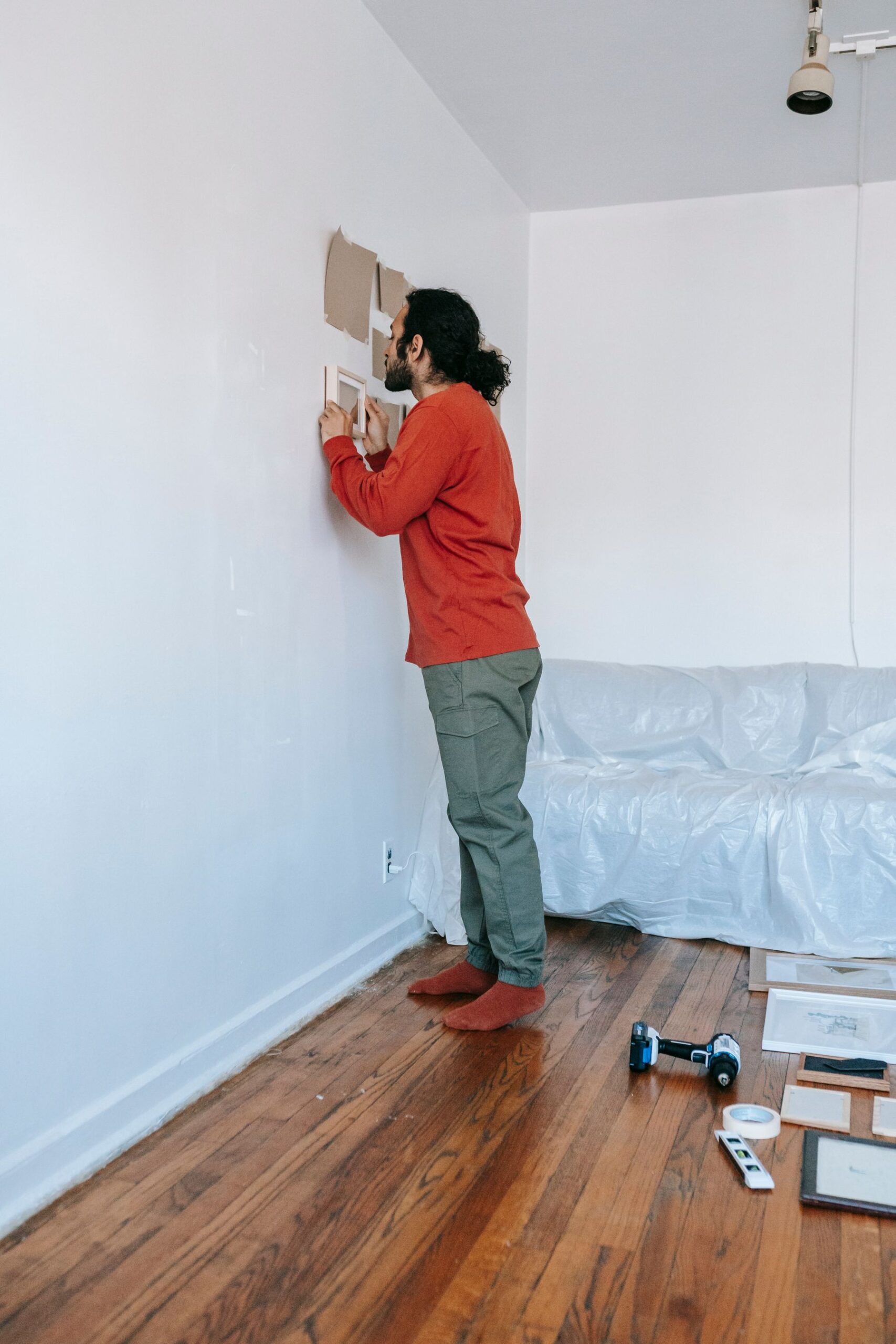
The physical handling in the photograph shows why rear construction belongs in the buying record. The customer handles the complete weight and depends on the specified attachment, not the front-facing product image. For production, define an appropriate verification for the attachment and finished assembly with a qualified technical owner; do not invent one universal load multiple for every wall material, product construction and hardware route. Archive the method, sample identity, result and any failure mode.

Engineer and test the pack around the route
Record unit protection, retail pack, inner quantity, master-carton quantity, carton material, corner and surface protection, carton dimensions, gross weight, SKU marks and closure. For metal relief, prevent protrusions from rubbing or loading against the carton. For framed art, control corner impact, face abrasion, internal movement and contamination. For multi-panel sets, number panels and verify hardware count.
ISTA distinguishes 1-Series integrity screening, 2-Series partial simulation and 3-Series general simulation procedures. Select the objective and procedure for the actual parcel, LTL, container or retailer-fulfilment route with a qualified packaging or testing partner. Record the tested product revision, pack revision, sample count, conditioning, procedure, pass criteria and post-test findings. Translate every failure into a named pack revision, then repeat the relevant verification instead of accepting an undocumented workshop repair. Avoid the unqualified statement “ISTA tested.”
After the pack survives its planned route, check the commercial result: unpack time, damaged protective surfaces, waste volume, barcode visibility, carton readability and whether the customer-facing pack still looks saleable. A design can pass a transport screen yet be unsuitable for store handling or e-commerce returns. Decision 15: release one named product-and-pack revision for one distribution route, and reopen the assessment when the route or pack architecture changes.
Confirm market obligations from actual materials and construction
For U.S. entry, determine tariff classification from the actual material and construction using the current USITC Harmonized Tariff Schedule and qualified broker review. Do not publish or reuse one wall-art HTS code across printed, framed, wood and metal products. Country-of-origin marking, importer records and other entry requirements also need product-specific review.
USDA APHIS states that a Lacey Act declaration can depend on plant material, an APHIS-listed HTS code, formal entry and available exemptions; its composite-material examples include paper, paperboard, particleboard, MDF and HDF. For EU sales, Regulation (EU) 2023/988 is the general product-safety framework and has applied since 13 December 2024. Build a destination matrix that names the importer or responsible person, material evidence, labels, filing owner, review date and unresolved question for each SKU family.
Boundary 5: destination obligations are not supplier certificates to collect blindly. The importer should identify material, construction, intended use, origin, market and responsible economic operator, then obtain qualified legal, customs or product-safety advice. Keep the review date because regulations, tariff schedules and official guidance change. A supplier declaration should point to the exact SKU and material version rather than a broad product family.

Archive the three columns as one dossier. A passing inspection report cannot close a failed pack test or an unresolved destination question, and a valid material record cannot release the wrong artwork revision.
8. Pilot the assortment, release the order and protect the reorder
A pilot tests receiving, display, selling and reorder control beyond one sample.
Use a pilot to validate selling and receiving
Choose representative risk: one core framed SKU, one feature metal or sculptural item, one multi-panel set and any SKU with custom artwork or printed packaging. During receiving, scan or identify the item, count components and hardware, inspect front and rear, measure carton and product, record damage, open time and packaging disposal, and compare the result with the approved revision.
During the selling trial, monitor display fit, customer questions, returns, damage, stock accuracy and the reorder information available to the store team. Name the observation window, store or warehouse locations, accountable reviewer and minimum evidence needed for a decision; otherwise a quiet launch may be mistaken for a proven range. A pilot may justify correcting depth, hardware information, pack marks or component protection before the full range. Decision 11: define pilot pass, correction and stop gates before the goods arrive.
Keep merchandising feedback separate from product nonconformity so a slow seller is not misreported as a factory defect.
| Gate | Invented pilot input | Release decision |
|---|---|---|
| Receiving identity | 12/12 cartons match SKU and revision | Pass; retain evidence |
| Set completeness | 1/20 sets lacks a hardware bag | Hold SKU; correct and recheck stock |
| Visible condition | 2/30 pieces repeat edge abrasion | Hold pack; validate correction |
| Display | Feature size needs an unplanned fixture | Revise feature brief |
| Reorder record | Quote omits released pack revision | Hold until corrected |
This example is a decision model, not an acceptance standard. The sample quantities and observations are invented. The point is to connect every finding to a specific SKU, affected stock, owner, correction and reopening condition.
Stop on repeatable red flags
Pause the order when the supplier cannot identify the rights owner, avoids rear-view evidence, changes a controlled material without a revision, mixes artwork versions, cannot explain the binding MOQ, excludes packaging from the quoted scope, substitutes hardware, or presents an unrelated test report as proof for the SKU. Schedule pressure does not correct these gaps.
Issue a written hold naming the SKU, revision, evidence gap, affected quantity, owner and reopening condition. Reopen only against a corrected record and named approval. Track repeated holds by cause and supplier; recurrence after correction can indicate a weak process rather than an isolated defect and should change sourcing or oversight conditions. The LANBORUI quality-control process can support product and packing checkpoints, but the buyer should still define the order-specific release criteria.
Separate a repair from a corrective action. Replacing one missing hardware bag can make one unit complete, but it does not explain why the packing process missed it or whether more units are affected. Ask for containment, cause, correction, verification and the revision or work instruction that prevents recurrence. Decision 16: close repeatable red flags only after affected stock and process evidence have both been addressed.

Carry the released identity into every reorder
A reorder should begin with the last released SKU, artwork file, bill of materials or drawing, finish sample, hardware, pack revision, carton data and open corrective actions. Ask the supplier to compare the proposed order with that baseline and declare changes before confirming price. Also review the age of the retained sample, supplier location, subcontractors, material availability, artwork licence term and destination requirements; time can make a previously valid approval incomplete.
Then separate commercial changes from physical changes. A new quantity may alter the price without changing the product. A new printer, substrate, frame profile, coating, hardware or pack needs an impact decision and may need new evidence. If a fixed assortment changes, review product identification and carton hierarchy as well. The GS1 GTIN Management Standard explains that changes to a predefined assortment can require a new GTIN; apply the relevant current identification rules to the actual configuration.
Decision 17: issue the reorder only when the quotation, purchase order and supplier acknowledgement name the same released product and pack revisions. This protects repeatability without pretending that production can never change.
Archive the new baseline after delivery so the next reorder starts from the actual released configuration.
Use this 15-point wholesale wall-art order checklist
- State market, channel, shopper and launch window.
- Assign each SKU one commercial role.
- Record product and packed dimensions and weights.
- Build the variation and identification tree.
- Select the route that owns dominant risk.
- Validate SKU-specific process and control evidence.
- Document rights scope and controlled factory file.
- Separate every MOQ layer.
- Normalize product, pack, quantity and Incoterm.
- Calculate landed cost per saleable unit.
- Approve digital, physical, product and pack stages.
- Control rear hardware and included parts.
- Agree defect classes and sampling plan.
- Validate pack against the distribution route.
- Release only when all records agree.
Archive the checklist with the PO, sample, quote, rights and carton records. To request a focused quotation, send LANBORUI the format, dimensions, quantity, market, artwork status and pack route through the contact page.
Source notes and review boundary
Primary sources cover copyright, composite wood, Lacey Act declarations, tariff classification, a hardware recall, sampling, package testing and EU product safety. GS1 and FedEx support identification and dimensional-weight examples.
Review current sources, the exact SKU, destination and contract before release. This workflow does not replace qualified legal, customs, testing, engineering or safety advice.