
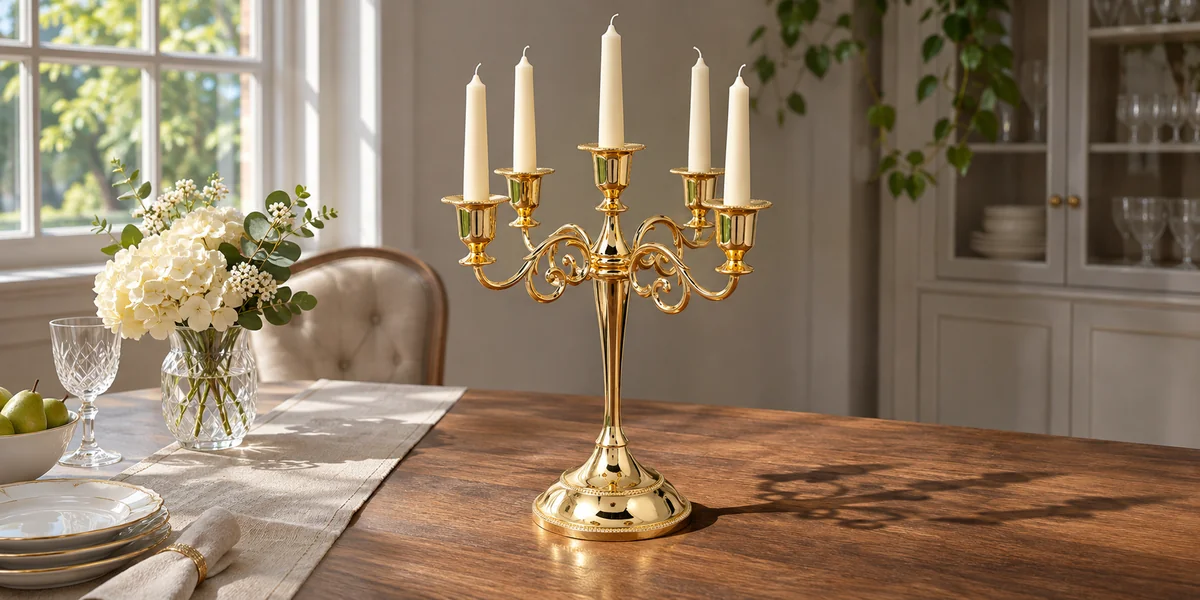
A candelabra is a decorative lighting fixture engineered with multiple branches to support several candles or luminaires simultaneously. By unifying separate points of light into a cohesive architectural structure, the piece creates an immediate focal point across dining tables, fireplace mantels, and ceremonial settings.
Grasping the precise meaning of a candelabra enables commercial buyers and interior designers to distinguish it from standard candleholders while drafting accurate product specifications. The term denotes a specific physical form; its decorative or sacred resonance stems entirely from the cultural tradition and architectural context in which it appears.
What Does Candelabra Mean?
A candelabra designates a branched luminaire holding multiple candles or light sources on a shared structural frame, typically configured with a weighted base, a central stem, and arms terminating in candle cups or bobeches.
Structural unity distinguishes the form: several branches joined to one central support constitute a candelabra, whereas multiple single holders grouped together remain an individual candleholder set. While the broader candle holder collection encompasses both configurations, matching finishes or decorative motifs do not alter these distinct functional classifications.

Candelabra Pronunciation and Word Origin
The word is conventionally pronounced kan-duh-LAH-bruh, placing primary emphasis on the third syllable. Linguists transcribe this phonetic pattern as /ˌkændəˈlɑːbrə/ in the International Phonetic Alphabet.
Etymologically, the term derives from the Latin candelabrum, an extension of candela, meaning candle. In classical Latin grammar, candelabrum serves as the singular noun while candelabra represents its plural counterpart.
Contemporary English usage widely accepts candelabra as an individual singular entity, adopting candelabras for the plural form. Both a candelabrum and a candelabra represent accepted stylistic conventions. In commercial publishing and wholesale merchandising, maintaining one consistent standard throughout a product catalog prevents inventory ambiguity.
Candelabra vs Related Terms
A candelabra defines a specific multi-branch form, whereas adjacent lighting terminology designates broader utility categories or distinct overhead installations.
| Term | Typical Form | Main Distinction |
| Candle holder | A cup, stand, or base supporting a candle | Broad umbrella category covering various candle formats and geometries |
| Candlestick | An upright columnar stand for a single candle | Typically engineered to hold one slender taper candle |
| Candelabra | An integrated multi-branch frame with several candle cups | Defined by radiating arm architecture from a common core |
| Chandelier | A multi-light branched luminaire suspended overhead | Defined by ceiling-hung installation rather than surface support |
These classifications naturally overlap. A candelabra remains a specialized subcategory of candle holder, with historical lexicons frequently cataloging it as a branched candlestick.
The primary operational divergence between a candelabra and a chandelier lies in installation geometry. A tabletop candelabra rests on a horizontal plane, while a chandelier suspends from structural ceiling points. When period decorative pieces or antique reissues create linguistic overlap, clear technical photography and mounting specifications resolve any functional uncertainty.
What Does a Candelabra Symbolize?
Within modern interior styling, a candelabra evokes formality, hospitality, and ceremonial dining. When incorporated into sacred observance, specific branch arrangements carry historic spiritual narratives. The physical geometry carries no universal symbolic meaning outside its assigned context.
Decorative Symbolism
In residential and hospitality styling, multi-candle displays signal refined entertaining and elevated occasions. Radiating tiers of living flame generate an intimate atmospheric glow that solitary pillar holders cannot replicate.
Museum archives substantiate this historical link with civic prestige and stately dining. The Russell-Cotes Art Gallery and Museum curates an 1880 silver presentation candelabra, originally gifted during an official municipal reception and subsequently displayed on the patron’s banqueting table.
In contemporary visual merchandising, surrounding seasonal accents define the aesthetic narrative. Incorporating a branched stand into Christmas centerpiece ideas anchors a holiday vignette through winter foliage, velvet runners, and ambient warmth. The bare metalware does not possess inherent seasonal meaning until styling establishes that context.
Religious Symbolism
Sacred associations belong strictly to specific liturgical designs rather than all multi-branch stands. In Jewish tradition, the historic Temple Menorah featured seven oil lamps supported by a central shaft and six curving branches. The Hanukkah menorah, designated as a chanukiah, features eight distinct festival lights alongside an elevated auxiliary light known as the shamash. Lighting this sacred piece commemorates the miracle of consecrated oil burning continuously across eight days during the rededication of the Second Temple.
Retailers and decorators must avoid treating ceremonial items as generic lifestyle accents. A decorative multi-arm piece does not function as a ritual artifact simply by sharing a similar candle capacity. Commercial copywriters should verify sacred traditions and scriptural requirements prior to assigning liturgical titles to commercial products.
Common Candelabra Styles and Uses
Candelabras vary substantially by mounting layout, silhouette, and candle capacity. Categorizing these variations simplifies catalog navigation:
- Tabletop candelabras rest on dining tables, sideboards, and fireplace mantels. Compact three-light arrangements fit shallow surfaces, while expansive five-arm models require generous clearance for projecting metalwork.
- Floor-standing candelabras elevate clustered candles on substantial pedestal columns. These dramatic pieces frame grand entryways, altar aisles, and ballroom stages where low tabletop fixtures would lack visual prominence.
- Wall-mounted branching holders fasten directly to vertical surfaces rather than resting on furniture bases. Specifiers catalog these fixtures as wall candelabras or multi-arm candle sconces according to their arm projection.

Stylistically, traditional variants showcase acanthus scrollwork, fluted columns, and baroque casting, whereas contemporary interpretations emphasize unadorned linear geometry and minimalist profiles. These labels characterize aesthetic presentation rather than verifying antique age or metallurgical purity.
Commercial collections often harmonize single candlesticks alongside large focal centerpieces. For example, the ornate European candelabra family balances compact single-taper holders alongside coordinated three-arm and five-arm editions. Wholesale buyers should specify precise variant stock numbers rather than assuming uniform branch counts across an entire design collection.
Choosing Candelabras for a Wholesale Collection
Curating a commercial candelabra catalog requires balancing spatial ergonomics with rigorous manufacturing tolerances, ensuring each design performs reliably across varied hospitality environments.
Proportions by Hospitality Setting
Scale fixture dimensions directly to the operational environment:
- Dining centerpieces: Prioritize low sightlines and weighted bases to facilitate table conversation.
- Credenza displays: Feature wider lateral spans and taller profiles for architectural wall framing.
- Event rentals: Require modular, tool-free assembly with reinforced threading to withstand frequent handling.
Pre-Production Quality Control Protocols
Before signing off on mass production, audit these essential manufacturing checkpoints:
- Confirm taper candle fit directly inside cups to accommodate base taper variances.
- Record assembled height, maximum span, and base footprint to optimize master carton density.
- Inspect structural weld integrity and balance on level surfaces.
- Require custom molded foam inserts to shield cantilevered branches from transit vibration.
Once these spatial requirements and quality baselines are defined, send LANBORUI your candelabra specifications with target candle calibers, technical drawings, order volumes, surface treatments, and destination ports to initiate engineering reviews and commercial pricing.
Frequently Asked Questions
How Should Candelabras Be Named in Wholesale Catalogs?
Use standardized titles specifying candle count, physical form, and surface finish, such as “Five-Light Tabletop Candelabra, Antique Brass Finish” paired with an individual SKU. Keep exact alloy compositions and packaging dimensions in technical specification fields, avoiding romanticized descriptors like “antique” without verified provenance.
Should Product Listings Specify Arm Count or Candle Capacity?
Lead with total candle capacity to avoid buyer confusion regarding light output. A fixture featuring four side arms and one central socket holds five candles, requiring explicit total capacity ratings alongside branch architecture details.
Does “Gold Candelabra” Describe the Material or the Finish?
The phrase denotes surface coloration rather than solid precious metal. Catalogs must separate base substrates from plated or coated treatments, using the sample approval process to document approved finish benchmarks before mass production.