
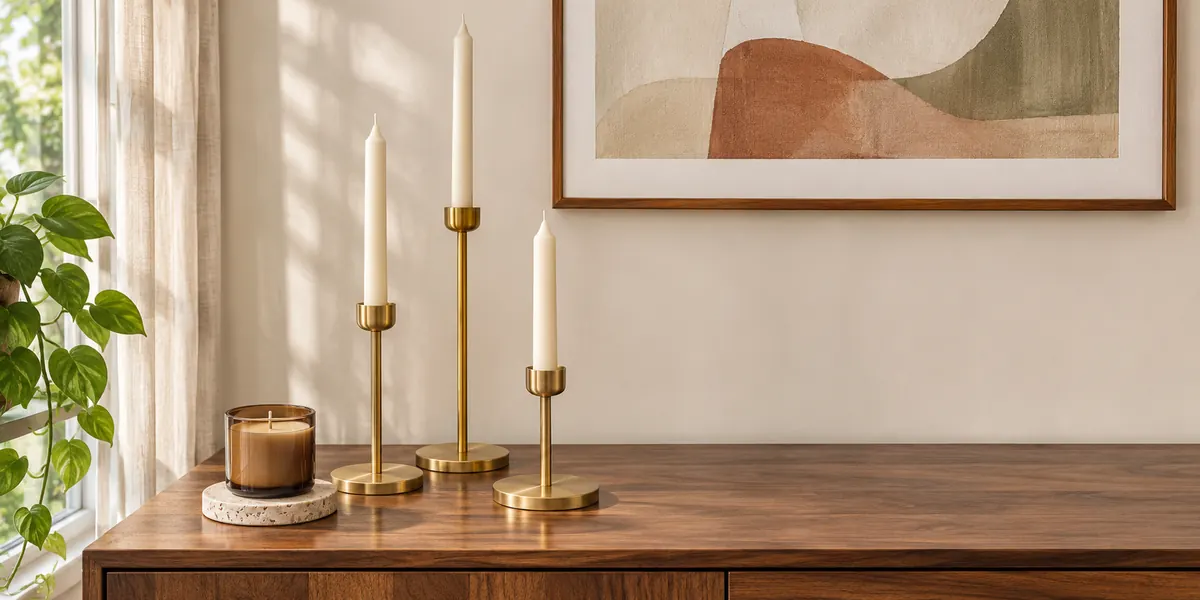
Effective candle styling balances focal placement with surface utility. A low jar candle fits an active coffee table, whereas slim tapers define a long dining table without crowding it.
Practical arrangements preserve clearance for everyday use, from setting down drinks to serving meals. These baseline layouts also establish consistent pairing rules for retail and project buyers.
Choose Decorative Candles That Suit Your Interior
Select shape and dimensions before evaluating color, fragrance, or active burning.
Candle Shapes and Sizes
A pillar candle provides low visual weight on open surfaces. Tapers supply vertical height while occupying minimal tabletop footprint. Jar candles function as standalone accents because the vessel integrates directly into the design. For sculptural candles with twisted or fluted shapes, keep surrounding space clear to preserve the silhouette. On compact surfaces, limit the arrangement to a single piece unless functional space permits additional units.

Candle Colors
Candle colors should reference existing room accents. Cream wax coordinates with linen textiles, while burgundy tapers pull tones from rugs or framed prints. Tonal pairings between candles and holders create an understated setting. A single contrasting shade provides visual emphasis if adjacent pieces remain neutral. For jar candles, factor in container glass and labeling alongside wax color. Tinted glass or high-contrast labels often form the dominant visual element.
Scent and Flame Options
Dining tables require unscented candles to prevent fragrance from competing with food. Scented varieties work best in dedicated sitting areas. If styling near textiles, paper, or in unmonitored zones, deploy battery-operated flameless alternatives.
Build a Balanced Candle Arrangement
Anchor the arrangement around a primary piece, then assign supporting roles to secondary items. Determine whether the setup is purely decorative or intended for active burning before selecting trays and accessories.
Focal Point and Height
Establish a clear focal point using a tall taper, a broad pillar, or a distinctive holder. Position shorter items adjacent to it, ensuring sightlines to the primary piece remain unobstructed from main viewing angles. A three-piece gold-tone candle holder set applies this principle through uniform finish across staggered heights, delivering visual depth without introducing conflicting finishes.

Holders and Accessories
Pair ornate holders with plain candles to preserve intricate detailing. Conversely, candles with pronounced texture or silhouette require simpler holders. Review single and multi-arm candle holders to align structural scale with table dimensions.
How to Display Candles on a Tray
Position the primary piece on the tray first, followed by secondary items, keeping part of the base surface exposed. Verify the usable flat dimension within the rim; any holder resting over a raised edge requires a larger tray or fewer components to ensure stability.
When styling alongside books, dried botanicals, or ribbons, keep wax candles unlit or substitute flameless units. Before ignition, transfer candles off decorative trays unless the tray surface is certified heat-resistant and level. Clear all combustible materials and adhere to required clearances.

Safe Placement for Lit Candles
Lit candles must rest in stable holders on level, heat-resistant surfaces away from high-traffic paths. Maintain a minimum clearance of 12 inches from combustible materials, such as curtains, paper products, and foliage. Space multiple candles at least 3 inches apart, or wider if specified by manufacturer guidelines. Position open flames away from drafts, pets, and children. Extinguish all candles before leaving the space.
Apply Candle Styling to Different Areas of the Home
Surface function dictates layout constraints. Coffee tables require usable surface area, dining tables demand open sightlines, and mantels or consoles accommodate vertical height.
Coffee Tables
On compact coffee tables, combine a low jar candle with a shallow dish on a small tray. Position the tray to preserve perimeter space for beverages and frequently used items. For tables that double as work or activity zones, a single flameless candle maintains visual balance without compromising utility.

Dining Tables
On round dining tables, group arrangements centrally while retaining perimeter space for place settings and serveware. A candelabra anchors the center point via a single branched frame. On rectangular tables, run a linear sequence of individual holders punctuated by service gaps. Test seated eye levels across the table. If candle height obstructs direct conversation, lower the taper profile or relocate taller holders to a credenza.

Mantels and Console Tables
On a fireplace mantel, flank central mirrors or artwork with paired symmetrical holders, or cluster staggered heights at one end for an asymmetrical profile. On entryway consoles, shift arrangements to one side to preserve clear drop zones for daily items. If shelving or artwork hangs directly overhead, keep candles unlit or use flameless models.
Retail and Project Buyers’ Checklist
Convert a finalized tabletop arrangement into a bill of materials specifying component types, critical dimensions, and unit counts. This provides buyers and suppliers with an aligned baseline for sampling and production orders.
Set Components and Quantities
Itemize every component within a single display and scale by the required set count. For instance, an order of 24 sets containing two holders totals 48 units. If the pair uses staggered heights, specify 24 units per height SKU to prevent uniform-size fulfillment errors. Clearly distinguish between bundled retail sets and individually boxed stock.

Candle Fit and Display Dimensions
Measure taper base diameters at the insertion depth and confirm complete pillar contact across holder plates. Conduct fit checks using physical candle samples in prototype holders; any tilt, wobble, or binding indicates tolerance mismatches that require revision before production. Record the total height, width, and depth of the assembled display with candles mounted. These figures confirm shelf clearance, packaging volume, and sightline tolerances.

Complete Sample Evaluation
Inspect the complete display under lighting conditions that match the commercial setting. Verify finish consistency, vertical alignment, and base stability across all components, then archive reference photography. Log model numbers, surface finishes, and revision codes into the sample approval record for buyer and vendor reference. Beyond visual and fit verification, functional burning displays require verification of thermal suitability between candle and vessel.

Order Contents and Packaging
Define shipment contents explicitly, separating included hardware from styling-only props. Inspect packed samples to verify that slender stems are supported, inserts are immobilized, and coated finishes are shielded from abrasion. Document packaging specs to benchmark bulk shipments against approved prototypes.

Share your candle holder requirements with LANBORUI, including reference images, candle base dimensions, and order volumes per SKU, to evaluate fitment and sample schedules.
Frequently Asked Questions
How Can You Refresh Candle Decor Without Buying New Pieces?
Relocate an existing setup to an alternate surface, or rotate individual holders into new pairings. For instance, transfer mantel holders to the dining table and repurpose the tray for a single sculptural piece. Reconfiguring existing inventory alters visual scale without adding new items.
How Do You Remove Wax From Candle Holders?
Allow the holder to cool fully before applying material-appropriate cleaning methods. Where manufacturer care guides permit warm water immersion, soften the wax deposit and wipe clean using a microfiber cloth. Do not scrape glass surfaces with metal blades, as surface scratches compromise structural integrity.
How Should You Store Decorative Candles When Not in Use?
Store decorative inventory in a temperature-controlled, dry, and dark environment. Store tapers horizontally to prevent heat-induced warping. Keep molded and sculptural candles in original cartons or partitioned trays to protect surface details from impact and contact deformation.