
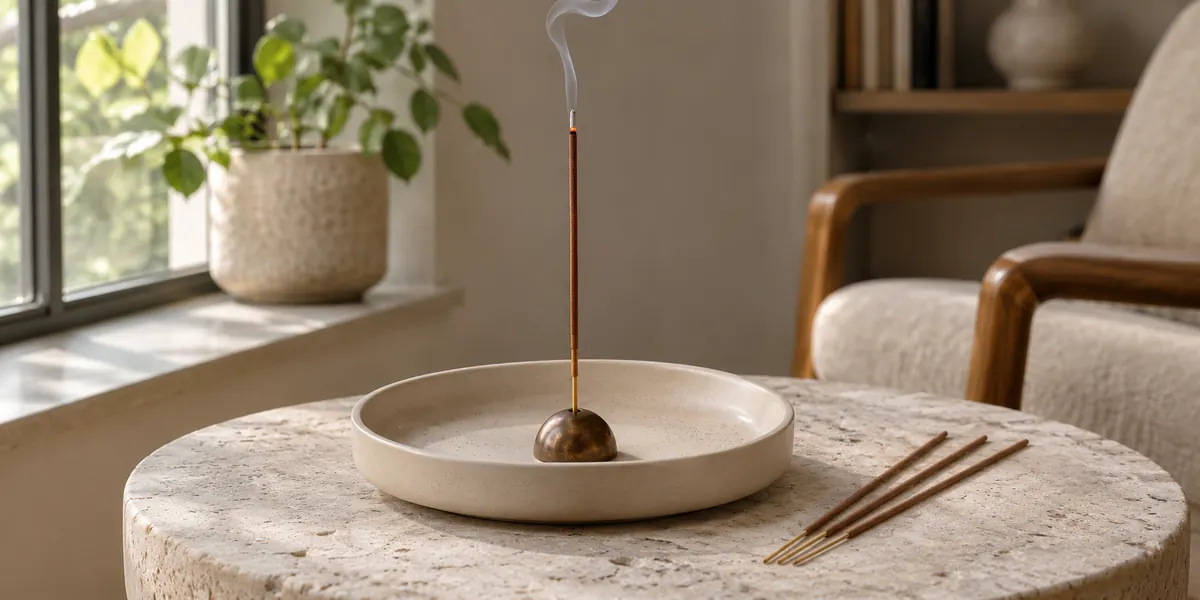
Incense is an aromatic material burned or heated to release fragrance, often producing smoke. It consists of either a single raw botanical, such as resin, or a prepared blend shaped into sticks, cones, or coils. Selecting the right format requires matching the scented compound to a compatible holder or heating method.
What Are the Main Types of Incense?
Incense is produced in sticks, cones, coils, and loose materials. Products fall into two combustion categories: direct-burning, which sustains a glowing ember after ignition, and indirect-burning, which requires a separate heat source. These operational differences determine the choice of incense burners and tools, as a support for a thin stick serves a different mechanical purpose than a vessel designed for heated resin.

Incense Sticks
Incense sticks are narrow lengths of prepared aromatic compound produced with or without a central support. Bamboo-core sticks coat a central splint with incense material, whereas coreless sticks consist entirely of the extruded incense compound.
Both release fragrance through smoldering: an ignited ember advances along the stick without an open flame. Physical diameter and core construction dictate holder fit. For example, the snail incense stick holder provides two aperture sizes and requires an independent ash tray, demonstrating that decorative supports and ash collection surfaces function as separate equipment requirements.

Incense Cones
Incense cones are compact, tapered blocks of prepared aromatic compound. Standard cones rest on a heat-resistant surface and burn downward from the tip. Backflow cones contain a hollow internal channel that directs smoke downward through the base. Producing this downward cascade requires a burner with an aligned intake hole; a standard solid cone placed on a backflow holder will not produce the downward effect.
Incense Coils
Incense coils wind the material into a continuous spiral, maximizing burn path within a compact footprint. Coils require a suspension rack or base that maintains structural alignment and captures falling ash. While coils often provide longer burn sessions than short sticks, total burn duration depends on product volume and composition rather than geometry alone. Check rated product burn times directly rather than assuming coil formats always burn longer than sticks.
Loose Incense
Loose incense consists of resin granules, fragrant wood chips, botanical powders, and unpressed blends. Common raw resins include frankincense and myrrh. Most loose materials require external heat matched to the material and operating environment. Electric heaters approved for loose botanicals are suited for indoor residential settings. Burning charcoal disks emit carbon monoxide and are not intended for routine indoor use. Certain blended powders sustain an ember on their own; because “loose” refers strictly to physical form, heating procedures vary by formula.
What Is Incense Made Of?
Incense formulations may contain aromatic materials, a combustible base, binding agents, and added fragrance. Formulations vary across formats: raw botanical resin contains no additives, whereas manufactured sticks often use single ingredients that fulfill several functions.

Aromatic Plant Materials
Fragrance profiles derive from woods, resins, herbs, roots, bark, and spices, including sandalwood, agarwood, benzoin, patchouli, cinnamon, and clove. Manufacturers use these botanicals individually or in custom blends. Because ingredient ratios alter the resulting profile, two products listing identical primary ingredients can produce noticeably different scents.
Product titles do not convey complete ingredient profiles. An item labeled “sandalwood” may contain genuine sandalwood timber, a fragrance oil blend, or a combination of both. Verify manufacturer technical disclosures rather than relying on trade names as ingredient lists.
Base and Binding Materials
Base materials provide physical volume and sustain regular combustion. Common base ingredients include wood powder, powdered bark, and charcoal. Binding agents provide the mechanical cohesion needed to shape and handle the compound. Certain bark powders become adhesive in water, functioning simultaneously as combustible fuel and structural binder.
These material roles frequently overlap. Aromatic wood powders contribute both scent and fuel, while select binders support combustion, eliminating the need for separate binder additives in every formula.
Added Fragrances
Certain incense varieties incorporate essential oils or fragrance blends, applied to pre-formed blanks or mixed into the compound during manufacturing. Other products derive their scent solely from the raw aromatic botanicals in the base.
Essential oils are concentrated botanical extracts, whereas general fragrance blends combine natural and synthetic aroma compounds. Commercial product comparisons should specify whether fragrance originates from raw botanicals, added aromatic liquids, or both to maintain accurate product descriptions.
What Is Incense Used For?
Incense serves primarily as ambient fragrance, an accompaniment to personal routines, and a component of religious or cultural observance. These applications reflect cultural tradition and personal preference rather than verified therapeutic efficacy.
Home Fragrance
Incense provides residential scenting for hospitality or everyday living, with profiles spanning woody, floral, herbal, and resinous categories. Scent preferences also guide gift curation. For recipients who use traditional bakhoor, Ramadan gift ideas include burner sets matched to the user’s specific heating preference, ensuring functional hardware compatibility alongside exterior styling.
Meditation and Personal Rituals
Incense frequently accompanies meditation, yoga, or reading routines. A consistent fragrance provides a sensory cue to mark focused periods and partition daily activities, functioning as a contextual habit marker rather than a clinical therapeutic aid.
Religious and Cultural Practices
Incense accompanies prayer, offerings, and ceremonial observances across global traditions. Japanese incense culture remains closely linked to Buddhist practices, while frankincense features prominently in Christian liturgies.
Altar arrangements require deliberate spatial planning. Guidance on decorating a home mandir details methods for organizing ceremonial vessels while preserving clear functional space. Active burners containing combustible materials require stricter clearance and heat resistance checks than passive decorative items.
How Do You Match Incense With a Holder or Burner?
Accessory selection depends on the combustion method, mechanical support requirements, ash containment, and thermal resistance. Visual design alone does not indicate functional fit.
- Sticks: The support orifice must hold the stick securely at the intended angle, with the base tray sized to capture ash throughout the burn.
- Cones: The contact surface must withstand concentrated thermal transfer from the base. Backflow cones require an aperture aligned with the burner’s intake channel.
- Coils: Supports must hold the spiral level without binding or mechanical stress, maintaining adequate tray clearance for ash collection.
- Loose materials: The heating vessel must correspond to the specified heat source. General heat tolerance does not make an open charcoal burner suitable for indoor use.
All burning equipment requires placement on stable, heat-resistant surfaces away from combustible goods, with continuous monitoring during operation. For retail assortments and gift sets, verify physical compatibility between incense formats and hardware before approving production. Document specifications for mounting apertures, ash catchment dimensions, and accessory components. Product photography props do not indicate included components.

For custom incense hardware procurement, send LANBORUI your product brief specifying target incense formats, model references, order volumes, destination markets, and packaging specifications to initiate sample evaluation and quotation.
Frequently Asked Questions
Why Does Incense Smell Different Before and During Burning?
Combustion and thermal release alter the volatile compounds emitted by incense, producing a distinct olfactory profile from the unlit product. Unlit incense emits room-temperature volatiles. Once ignited, vaporized aromatic botanicals blend with combustion byproducts from smoldering base powders and, when present, the central bamboo core.
Why Does My Incense Stick Keep Going Out?
Sticks extinguish primarily because of moisture absorption or because an ember failed to establish before the flame was extinguished. Proper ignition requires allowing the flame to burn until a stable glowing ember forms. Sticks exposed to damp environments require drying per manufacturer guidelines before use. For properly stored sticks that repeatedly self-extinguish, contact the supplier rather than applying additional heat.
How Should Incense Be Stored?
Store incense away from direct sunlight, moisture, and elevated temperatures, following manufacturer instructions. Retain original packaging to preserve batch details, scent designations, and handling instructions. Shelf life varies by category: dipped fragrance sticks and pure botanical blends change at different rates, precluding a single standardized expiration window.