
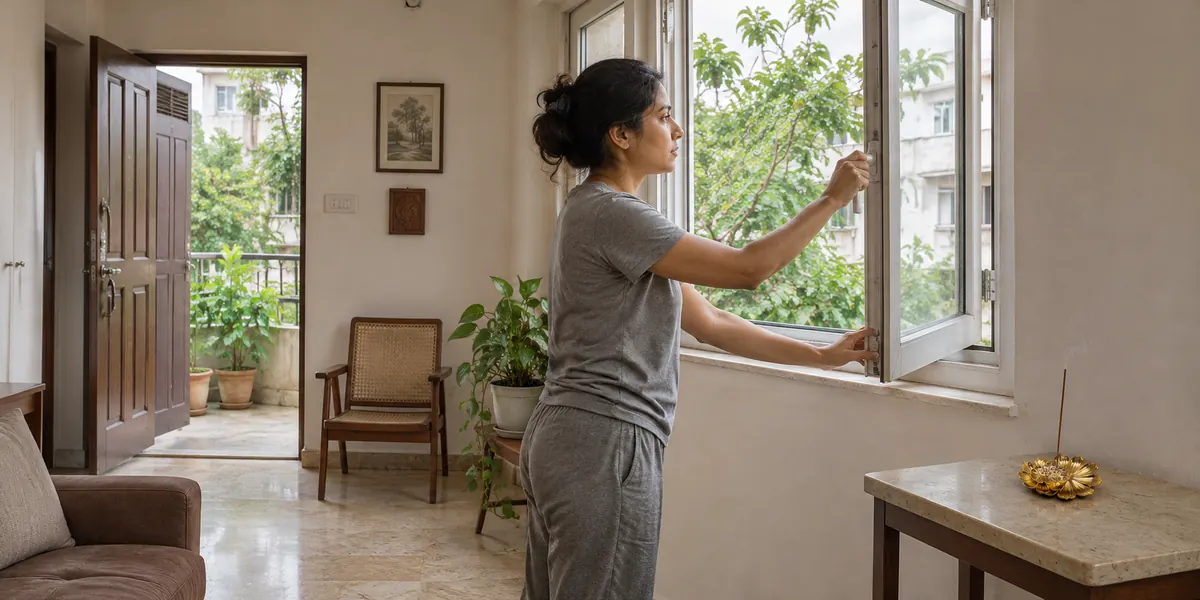
Ventilating a room during incense burning requires introducing clean outdoor air while providing an exhaust path for smoke. Open designated windows, use outward-facing fans when necessary, and maintain ventilation after the ember is out. Circulating air within a closed room does not remove pollutants.
These guidelines apply to stick incense. Formats involving charcoal require separate heat-handling procedures and instructions.
Why Ventilation Matters When Burning Incense
Ventilation controls the accumulation of combustion byproducts. Burning incense generates fine particles and gases capable of irritating airways. Introducing outdoor air dilutes these compounds, while outgoing air expels a portion outside.
Visible haze and fragrance strength do not correlate reliably with air quality. Weak scent does not verify low pollutant concentrations, and products sold under “natural” or “low-smoke” claims still emit irritants. Reducing burn frequency cuts emissions directly, whereas ventilation alone does not eliminate exposure risks.
How to Ventilate a Room When Burning Incense
Establish air exchange prior to lighting the stick and keep it active throughout burning. Replace smoky room air without generating strong drafts across the burning tip.

Step1: Check Indoor and Outdoor Conditions
Check ambient outdoor air quality and confirm functional ventilation openings before lighting. During wildfire smoke or severe outdoor pollution, opening windows pulls additional particulates inside; postpone burning whenever clean replacement air is unavailable.
Indoors, identify an intake path for incoming air and an exhaust point for outgoing air. Verify outward ducting through equipment manuals, building schematics, or visible exterior vents. Recirculating range hoods simply return air indoors. If an exterior exhaust outlet cannot be verified, do not treat that fan as outdoor ventilation.
Step2: Create a Path for Fresh Air
Open a window and, when available, a second exterior opening on another wall to establish cross-ventilation. Interior doors contribute to ventilation only if the adjacent room leads to an active exhaust route. Opening doors into closed hallways disperses smoke into the rest of the building. Position incense away from direct drafts. Differences in wind pressure, aperture dimensions, and floor plans prevent any fixed window gap from guaranteeing sufficient airflow.
Step3: Use Fans When Needed
Deploy a fan to assist exhaust when natural air movement is insufficient. Mount a stable fan at an open window facing outward, maintaining an open intake elsewhere for makeup air. Keep fan currents away from the incense stick and ash tray. Avoid exhausting smoke toward room occupants or into adjoining occupied spaces. Ceiling fans only mix indoor air without discharging contaminants. Built-in bathroom or kitchen exhaust fans provide effective extraction if they vent outdoors and draw air directly from the burn area.
Step4: Maintain Air Exchange During and After Burning
Maintain active air exchange throughout the burn cycle and after extinguishing the ember. Quenching stops new smoke generation, but suspended particles and gases remain in the room until displaced.
Clearing times vary by room volume and smoke output. Heavier emissions require longer clearing periods under identical conditions, while higher air exchange rates clear spaces faster. Do not treat scent dissipation as confirmation of clean air. If smoke concentrates or causes irritation, extinguish the stick immediately rather than adjusting fans while burning continues.
How to Burn Incense Safely Indoors
Indoor burning requires dedicated holders, unobstructed surroundings, and continuous supervision. For retailers, establishing a documented sample approval process ensures production units match agreed hardware configurations and instruction revisions.
Choose a Stable, Heat-Resistant Incense Holder
Select a holder engineered for the specific incense format and place it on a level, heat-resistant surface. The mount must secure the stick firmly so that falling ash drops directly into the catchment tray. Verify stick diameter and burning angle before ignition. Loose sockets allow sticks to tilt or dislodge. Metal material alone does not confirm adequate thermal resistance. For units with movable supports, such as the leaf-form incense ash-catcher tray, check socket fit, tilt angle, physical stability, and projected ash trajectory before use.

Keep Incense Away From Flammable Materials
Maintain clear separation between the burning tip, falling ash, and combustible items such as curtains, paper, garments, and bedding. Provide overhead clearance in addition to surrounding perimeter buffers. Anticipate moving textiles; curtains hanging clear in still air can billow into the ember once windows open. For prayer setups, reference home mandir layout guidance to organize clearances around fabrics and garlands. Keep the burning zone clear when rotating ritual decorations.
Never Leave Burning Incense Unattended
Remain in the room and alert while incense burns; extinguish the ember before stepping away. Position burners outside the reach of children and pets, and away from paths where clothing might brush against them. Do not burn incense when drowsy. Lidded or enclosed incense burners and tools require equal supervision. A closed lid does not confirm that an internal ember has stopped burning.
Extinguish Completely Before Leaving or Sleeping
Extinguish incense completely prior to leaving the room or sleeping, verifying that all glowing embers have ceased. Follow manufacturer extinguishing instructions. If water quenching is permitted, submerge only the tip without wetting the holder itself. Never pour water over hot burners. Keep the holder and spent ash on the heat-resistant base until cold to the touch. Never dispose of warm ash into waste containers.

How to Handle Limited Ventilation
When outdoor air exchange is restricted, curb emissions at the source rather than increasing indoor circulation. In single-window rooms, operate outward exhaust setups only if replacement air can enter from another point. Larger rooms allow greater initial dilution but still require active air turnover. Windowless spaces require mechanical systems that supply fresh outdoor air or vent room air outside. Standard air conditioners typically cool and recirculate existing room air.
Portable air cleaners serve as secondary mitigation. HEPA filters capture particulate matter, while heavy activated-carbon filters extract select gases. Purifiers do not capture all combustion pollutants, and filtration does not substitute for source control. If sufficient air exchange cannot be achieved, postpone indoor burning or relocate outdoors. Lower smoke visibility does not indicate that ventilation limitations have been resolved.

What Brands and Retailers Should Include in Incense Use Instructions
Provide user instructions configured for the exact burner model and incense format sold. Generic instruction cards often overlook model-specific differences in stick retention, ash containment, and thermal loads.
Include:
- The designated incense format and any excluded fuel types or heat sources.
- Assembly and stick-mounting steps, covering removable supports.
- Surface requirements and clearance buffers from combustible materials.
- Guidelines for ventilation, supervision, extinguishing, cooling periods, and ash cleaning.
- An explicit list of included components and accessories.
Ensure all documentation matches approved production samples and current packaging revisions. Require supplier verification data for thermal safety claims; visual reviews cannot substantiate heat ratings. Avoid unsubstantiated claims such as “safe in any room” or “no ventilation needed.”

To review an incense accessory project with LANBORUI, submit your product brief with the intended incense format, product reference, volume, target market, and packaging specifications for technical evaluation and quotation.
Frequently Asked Questions
Can Burning Incense Trigger a Smoke Alarm?
Yes, incense smoke can trigger residential smoke detectors. Alarm activation depends on smoke concentration, detector design, and installation location. Never disable or cover detectors to burn incense. Do not assume an alarm is exclusively caused by incense smoke. Follow established evacuation plans; if fire indicators are present or a fire cannot be conclusively ruled out, evacuate immediately and contact emergency services from outside.
Can Incense Smoke Leave Residue on Walls and Furniture?
Yes, airborne particles from incense smoke settle onto walls, furniture, and surrounding surfaces. Repeated use causes cumulative surface deposits, though discoloration alone does not isolate the exact particulate source. Once equipment and ash are fully cool, wipe compatible hard surfaces with a damp cloth in accordance with surface care instructions.
Does Burning Incense Remove Odors or Only Mask Them?
Incense masks ambient odors with fragrance; it does not eliminate the odor source. For recurring odors, identify and remediate the underlying cause, such as moisture or decomposing waste. Burning fragrance over unaddressed odor sources leaves the root issue intact while adding combustion pollutants to the room.
External Sources
- US EPA — Sources of Indoor Particulate Matter
- US EPA — Guide to Air Cleaners in the Home
- London Fire Brigade — How to Use Candles and Incense Safely
- Health Canada — Fine Particulate Matter
- Gloucestershire Fire and Rescue Service — What Are False Alarms?
- New York State Department of Health — Odors & Health