
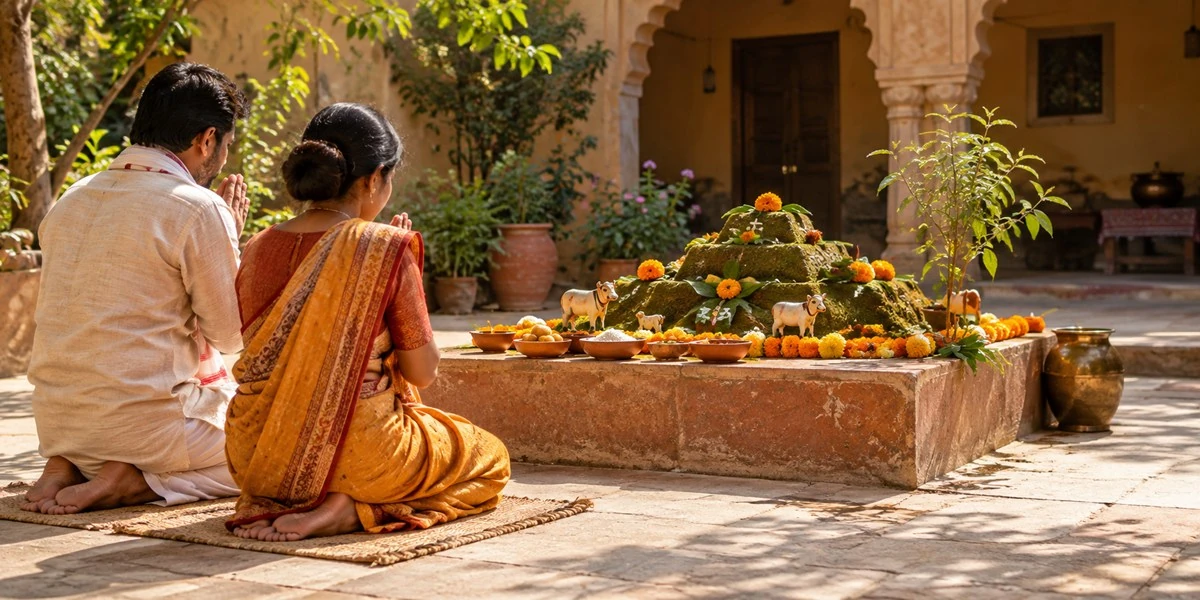
Govardhan Puja is a Hindu festival honoring Lord Krishna and Govardhan Hill. The celebration recalls the traditional account of Krishna lifting the mountain to shelter the people of Braj from a destructive storm. Observances traditionally include worship, food offerings, and community meals.
Familiarity with these traditions helps retailers curate culturally relevant product selections featuring items with a clear, functional purpose.
Why Is Govardhan Puja Celebrated?
Govardhan Puja celebrates Krishna’s protection of his community while teaching devotion, humility, and gratitude for life-sustaining resources.
According to Hindu tradition, the people of Braj initially prepared offerings for Indra, the deity associated with rain. Krishna encouraged them to honor Govardhan Hill instead to recognize the land supporting their cattle and livelihoods. Angered by this change, Indra sent heavy rain. Krishna then lifted Govardhan Hill, giving the villagers and their animals shelter beneath it. Indra eventually acknowledged Krishna’s divine power and withdrew the storm.
This story connects worship with the community’s natural surroundings, emphasizing a deep appreciation for the resources supporting everyday life.

When Is Govardhan Puja Celebrated?
Govardhan Puja generally falls on Kartik Shukla Pratipada, the first lunar day of the bright half of Kartik, occurring usually in October or November.
The festival commonly follows Diwali, though it does not always land on the exact next calendar day. The timing of the lunar day can leave a brief gap between the celebrations.
In 2026, Govardhan Puja falls on November 10 in New Delhi. The appropriate worship period is calculated for each specific location. Families attending a temple celebration should simply follow that specific temple’s announced schedule.
What Does Annakut Mean?
Annakut means mountain of food. The term describes an abundant arrangement of food offered to the deity to express deep gratitude and devotion. Devotees often arrange vegetarian dishes in a large display recalling the shape of Govardhan Hill. The name also refers to the broader festival celebration itself. Govardhan Puja and Annakut remain closely connected, though different traditions emphasize different aspects of the observance.
Some celebrations feature an offering of 56 specific preparations known as Chhappan Bhog. This number acts as a traditional guideline rather than a strict requirement for every household. The scale of the offering varies widely by community and tradition.

How Is Govardhan Puja Celebrated?
Govardhan Puja is celebrated through the worship of the hill or a symbolic representation, alongside food offerings, prayers, and reverence for cows. Practices vary widely among families, regions, and religious communities.
Worshipping Govardhan Hill
Devotees worship Govardhan Hill itself or create a symbolic representation at home or in a temple. Some household traditions shape this representation from cow dung, while other celebrations use food. Flowers and offerings accompany the worship. Devotees may also perform parikrama, the act of walking around a sacred object as a sign of devotion. The exact representation and ritual details follow the specific tradition of the household or temple.
Offering Food and Sharing Prasad
Prepared food is first offered in worship and then shared as prasad, a blessed food received after the offering. Temple celebrations often include rice, lentils, breads, sweets, and dairy preparations accompanied by prayer and devotional singing. An aarti ceremony involves offering light before the deity. Sharing prasad brings the celebration directly into community life, allowing people to take part through preparing, offering, and distributing food.
Honouring Cows
Cows receive special attention given their connection with Krishna and their importance in the pastoral life described in the festival’s story. Celebrations involve decorating, feeding, and worshipping cows. This reverence connects the religious account with deep gratitude for the animals sustaining the community. The practice stands as a distinct religious observance rather than just another form of festive decoration.

Which Products Fit a Govardhan Puja Collection?
Puja trays, ritual accessories, suitable serving pieces, and coordinated gift sets serve as excellent starting categories. Every item requires a defined functional use rather than simply looking festive.
Puja Trays and Accessories
A puja thali organizes items for worship. Depending on the customer’s practice, an arrangement might include small bowls, a spoon, a handbell, or other accessories. Retailers should start with a manageable tray featuring components that fit securely within it. Review the usable surface, ease of handling, and access to each item. Curating a coordinated handbell collection alongside matching trays provides a complete worship solution. Any accessory intended to hold a flame or burning incense needs strict material confirmation. A decorative appearance alone never establishes heat suitability.

Annakut Serving Pieces
Plates, bowls, and trays help organize food offerings. Direct food contact must be distinguished entirely from decorative display. Retailers must request material and finish documentation covering the intended food type and serving temperature for any item holding food directly. A gold-tone or silver-tone appearance does not prove food-contact suitability.
Decorative trays can alternatively carry separate food-safe dishes. Larger arrangements require accessible serving space and stable placement over elaborate decoration reducing usable capacity.
Festive Gift Sets
Coordinated assortments suit customers seeking a complete presentation rather than separate pieces. A comprehensive custom gift set might bring a decorated tray together with handbells, bowls, a spoon, and matching accessories. The listed arrangement acts as a product reference requiring final component agreement before bulk ordering. Retailers should favor clear combinations with understandable purposes. Adding unnecessary pieces only increases the number of parts to explain, protect, and replace.
How Should Puja and Gift Retailers Plan Their Collection?
Puja and gift retailers must connect customer traditions, product configurations, and delivery milestones before placing an order. Establishing a clear sourcing and production timeline separates sample approval, manufacturing, and shipment phases effectively.
Match Local Traditions
Build the assortment directly around the practices of the local customer base. Ask established buyers or religious organizers which accessories they use, which symbols feel appropriate, and whether they prefer individual pieces or complete sets. A household collection might favor compact arrangements, whereas a temple order requires larger quantities and higher serving capacities. Keep those distinct uses separate instead of offering one generic configuration for everyone.
Define Sets and Packaging
Write a fixed contents list for every sellable set detailing each component’s quantity, dimensions, and finish. Approve the complete arrangement together. A bowl looking suitable by itself might crowd the tray when placed beside other accessories. Verify lid fit, handbell operation, and the clearance needed to remove each piece.
Packaging must keep components separated and protect raised decoration. Decorative gift boxes often require an additional outer shipping carton. Buyers should leverage a structured quality control and packing process to ensure product dimensions, inserts, and artwork approvals align perfectly.

Plan for Seasonal Launches
Work backward from the date products must hit the shelves rather than calculating from the festival date alone. Allocate separate time blocks for selection, sample changes, packaging approval, production, inspection, shipping, and receiving. Confirm the exact event starting the supplier’s production schedule. Clarify whether the quoted finish date means packed goods or actual carrier handover.
Reduce unresolved customization if the schedule becomes too short. A simpler, pre-approved configuration limits pending decisions and prevents release delays. Retailers ready to develop a tailored seasonal assortment can submit project requirements directly to the LANBORUI sales team. Supplying clear details regarding product references, quantities, and delivery targets streamlines the quotation process.
Frequently Asked Questions
Can Govardhan Puja Products Be Used for Other Festivals?
General-purpose trays, bowls, and handbells often suit other religious or festive occasions. Reuse should follow the item’s intended function and the specific customer’s practice. Products featuring festival-specific wording or religious imagery require a closer review than plain serving pieces. Retail descriptions must explain supported uses without presenting every item as universally appropriate.
What Product Information Should Retailers Include on Packaging?
Packaging must identify the product, exact set contents, dimensions, intended use, and verified care instructions. Distinguish decorative color from actual material composition. State any confirmed restrictions on food contact, heat, or cleaning explicitly. Keep the contents description identical to the boxed version allowing customers to identify missing pieces easily.
What Images Should Buyers Request Before Listing the Products?
Buyers should request photographs of the complete set, individual components, important details, and the packed product. Include a scale reference or dimension image alongside close-ups of handles, lids, decoration, and surfaces. Listing images must show the approved version and clearly distinguish included items from styling props. Use generated lifestyle images strictly as supplementary illustrations rather than evidence of the supplied product.